Electrolytic production
Sell certified volumes at a premium with proof of the renewable supply, the production conditions and the resulting carbon intensity attached to every delivery.
Digital Product Passport platform for hydrogen
Certified hydrogen only earns its premium if the claim survives storage, blending, transport and conversion. H2DPP gives producers, traders and their auditors one verified record of origin, emissions, custody and certification — from the electrolyser to the customer’s gate.
The business case
The certificate is the easy part. The hard part is keeping the proof attached to the molecules through every tank, pipeline, transfer and conversion step between you and the buyer.
Where value leaks today
What changes with H2DPP
The outcome is commercial, not just administrative: a premium you can defend, an audit you can pass, and a buyer conversation that ends in a document rather than an argument.
The platform
A working Digital Product Passport for hydrogen and its derivatives — delivered as a product, configured to the schemes and counterparties you actually deal with.
Record where every volume was produced, from which energy source, under which conditions — and keep that origin attached as the volume moves.
Supports the custody models your scheme requires — identity preservation, segregation and mass balance — and keeps them straight when hydrogen from several sources shares the same infrastructure.
Carbon intensity and lifecycle emissions calculated on the recognised methodologies, carried with the volume and reported in the units each scheme and buyer expects.
Scheme evidence stays attached to the right volume, and the rules of the certification boundary you are operating in are applied as you go rather than checked afterwards.
Counterparties can confirm that a claim is genuine, current and unspent — without you handing over commercial data they have no business seeing.
Every entry is timestamped and attributable. Auditors and verification bodies get a trail to inspect instead of a reconstruction to challenge.
Share exactly what each partner, buyer or authority needs, at the level of detail you choose, with a record of who was given access to what.
Every consignment gets a passport your customer can scan or open from a link — readable by a person, and readable by their systems.
Outcomes our customers ask for
Use cases
Hydrogen supply chains fail traceability in specific, predictable places. These are the ones customers bring us first.
Sell certified volumes at a premium with proof of the renewable supply, the production conditions and the resulting carbon intensity attached to every delivery.
Hydrogen from several producers in one tank or network. Each owner’s quantity and each buyer’s claim stay correct, reconciled and separately reportable.
Hand the buyer’s compliance team the evidence pack they ask for on the day the deal closes, not six weeks later.
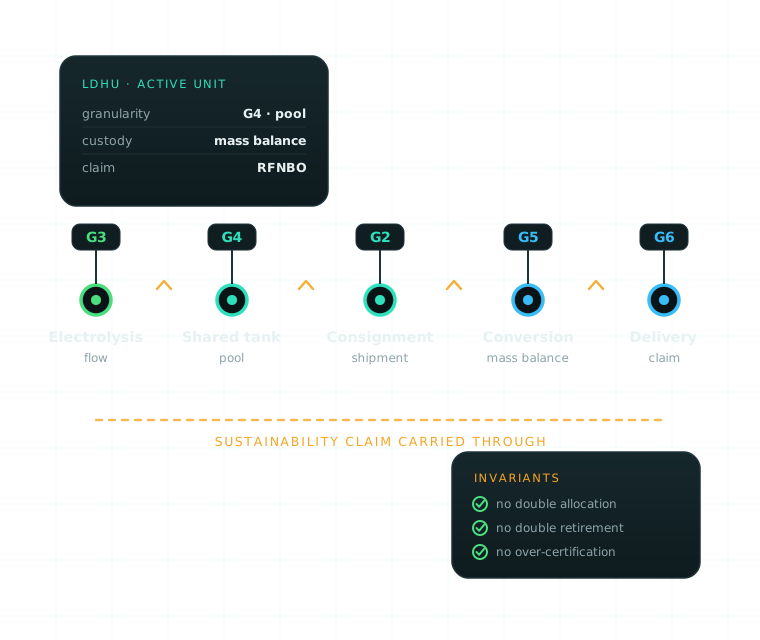
Conversion does not break the record. The sustainability claim carries into the derivative under the allocation rules of the governing scheme, and stays traceable in both directions.
Bring imported volumes into a form that EU schemes and customs-facing reporting will accept, with the origin evidence intact rather than asserted.
Show at the dispenser, and in the fleet operator’s reporting, that the hydrogen delivered was the certified hydrogen that was paid for.
Who it’s for
Everybody in a hydrogen chain needs the same facts and almost never needs them in the same form. Pick your seat at the table.
H2DPP does not certify anything. It makes the operator’s evidence inspectable so that your scheme’s decision rests on data you can trace.
Compliance
Unlike textiles, hydrogen does not wait on a product-specific ecodesign act. RFNBO rules, the market package and the low-carbon methodology are in force now — and every one of them asks you to show your working.
Feb 2023
Delegated Regulations (EU) 2023/1184 and 2023/1185 set the renewable-electricity conditions and the lifecycle greenhouse-gas methodology for renewable fuels of non-biological origin.
5 Feb 2025
Regulation (EU) 2024/1789 starts to apply. Member States had until 5 August 2026 to transpose Directive (EU) 2024/1788.
May 2025
CertifHy, RedCert and ISCC EU approved for RFNBO certification, with the first certified volumes traded the same year.
8 Jul 2025
Adopted by the Commission, completing the framework alongside the Hydrogen and Decarbonised Gas Market Package.
Nov 2025
Commission Delegated Regulation (EU) 2025/2359 sets how emission savings for low-carbon fuels are calculated.
2026
ISO 19870-1:2026 replaces ISO/TS 19870:2023 for production-gate emissions, and ISO 22095 gains Amendment 1 plus Parts 2 and 3 on chain of custody.
2028
The European Network of Network Operators for Hydrogen begins ten-year EU-wide network development plans and cross-border coordination.
How H2DPP helps you meet them
Hydrogen also falls within the strategic technologies in scope of the ESPR, so the EU Digital Product Passport Registry and the horizontal DPP standards are part of the same trajectory. We track them so your passports stay valid as the requirements land.
Aligned to the frameworks your auditors already use
Getting started
You do not need an enterprise transformation to get a working hydrogen passport. You need one supply chain, the data that already exists around it, and a few weeks.
Half a day on your actual chain: where the hydrogen goes, which scheme governs it, who needs to see what, and where today’s evidence breaks. You leave with a scope and a number.
One production site and one route, running on your real data, with the passport your buyer or certifier would actually receive. Weeks, not quarters.
Connect the systems already producing the data — metering, energy management, ERP — extend to further sites, routes and derivatives, and bring counterparties on.
Why DeepCloudLabs
FAQ
A hydrogen Digital Product Passport platform: your volumes and consignments carry verified origin, emissions, custody and certification data; your customers get a passport they can scan or open from a link; your auditors get a trail they can inspect; and your team gets one place to answer the question “prove it”.
No. CertifHy, ISCC EU and RedCert remain the certifying bodies and their rules still decide what you may claim. H2DPP is the system that keeps their evidence attached to the right volume as that volume is stored, blended, shipped, converted and finally delivered — which is where certified claims normally come apart.
H2DPP takes data from the systems that already produce it — metering and process historians, energy management, ERP, existing certificate registries — and publishes passports and reports back out. It is designed to sit alongside your stack, not to replace it, and it does not require you to re-platform to get a first passport out.
You decide, per counterparty. A customer can verify that a claim is genuine, current and unspent without seeing your prices, volumes or supplier relationships. Auditors get scoped access to the client and period they are examining. Every grant of access is itself recorded.
That is the better time to start. Hydrogen certification is already binding, buyers are already asking for proof, and the operators who can produce it are the ones defending a premium today. Starting early also means the evidence for your first mandatory reporting period already exists rather than having to be reconstructed.
Where a scheme permits certificate-based trading, H2DPP handles it. Where it does not — RFNBO certification under RED III, Article 30, being the obvious case — the platform will not let you record a claim that the governing scheme forbids. That boundary is enforced by the system rather than left to a policy document and someone’s memory.
Conversion does not break the record. The sustainability claim carries into the derivative according to the allocation rules of the governing scheme, and the history stays traceable in both directions — so a buyer of the ammonia can still see what the hydrogen was.
No. What matters commercially is that records are append-only, independently auditable and verifiable by a counterparty who does not trust you by default. We use cryptographic verification where a counterparty genuinely needs it, and we do not charge you for infrastructure your use case does not require.
A pilot on one production site and one route is measured in weeks. Scope and price come out of the scoping workshop, which is where we would rather start than in a proposal document. Book a walkthrough and bring your hardest chain.
A commingled tank, a conversion step, a consignment that has to prove delivery to a buyer who will not take your word for it. We will walk it through the platform and show you what your passport would look like.